The Cherryleaf Podcast
Cherryleaf’s podcast on technical writing and becoming a better business communicator. www.cherryleaf.com





Episodes

Jun 21, 2026
Jun 21, 2026
52 min
In this episode, Ellis Pratt talks with Ben French, leadership development consultant and business coach, about compassionate compliance: how leaders can use policies, procedures, and regulation to protect their people and meet legal obligations without creating a culture of surveillance, bureaucracy, or micromanagement.
Drawing on their shared experience of helping organisations develop clearer policies and ways of working, Ben and Ellis explore why compliance so often feels like the enemy of good work. They discuss the points at which organisations typically start to struggle with compliance, especially as they grow, prepare for investment, face audit requirements, or need to satisfy external regulators and funders.
They also look at how policies can support better decision-making, why simplification is often more effective than adding more rules, and how leaders can balance oversight with autonomy so people still feel trusted to do their jobs.
Topics covered include:
Why growing organisations often experience friction around compliance and decision-making
How external scrutiny from investors, auditors, regulators, or funders can change the way organisations manage risk
The difference between information that satisfies auditors and guidance that helps staff do the work
How over-policing processes can damage morale, slow down decisions, and reduce ownership
Why compassionate compliance means leaders absorbing risk rather than simply passing it down to frontline staff
The role of policy in setting boundaries while still allowing people to use judgement
How AI creates new challenges around responsibility, decision-making, and “cognitive surrender”
Why good policies should be living documents that are reviewed, simplified, and pruned over time
Ben also shares examples from organisations that have struggled with overly complex compliance processes, and discusses where leaders should start when they inherit a broken compliance culture: listening to staff, identifying legal requirements, understanding what assurance the board really needs, removing unnecessary rules, and prioritising work based on risk.
Find out more about Ben French at ben-french.com Visit Cherryleaf at cherryleaf.com
May 20, 2026
May 20, 2026
26 min
In this episode, Ginny Critcher talks with Ben French, leadership development consultant and business coach, about what it really takes to transition an organisation from founder-led to a more structured, process-driven way of working.
Drawing on their shared experience working with a global football organisation, Ben and Ginny explore the tension between preserving the culture that made a company successful and introducing the processes needed to help it grow — or survive contraction. They discuss when organisations typically need to make this shift, why getting the calibration of process right matters as much as having process at all, and how documenting culture and policy are really the same thing.
Topics covered include:
Why organisations of around 10–30 people often hit a tipping point
The challenge of adapting central frameworks to work across different countries and cultures
How external consultants can help organisations ask the right questions — not just do the work
The role of decision-making clarity in shaping culture
How to communicate that policy is always a work in progress
Ben also shares what he's been working on since, including a project with the British government focused on embedding new behaviours as different parts of the Foreign Office come together.
Find out more about Ben French at ben-french.com Visit Cherryleaf at cherryleaf.com

Feb 16, 2026
Feb 16, 2026
13 min
When two companies merge, the announcement typically focuses on synergies, market share, and shareholder value. What gets far less attention, until it becomes a problem, is the intricate work of actually integrating two distinct organisations into a functioning whole. At the heart of this challenge lies something seemingly mundane but absolutely critical: policies and procedures.
The integration blueprint for any merger or acquisition must address not only systems and structures, and also the fundamental question of how work gets done.
It’s here, in the weeds of operational detail, that many integrations stumble.
See also our blog post
https://www.cherryleaf.com/2026/02/ma-integration-blueprint-why-procedures-matter-more-than-you-think/

Dec 11, 2025
Dec 11, 2025
21 min
In this episode, we explore how AI is reshaping the technical writing profession and what skills will matter most in the coming years. While AI dominates the conversation about the future, we dig deeper into what this means for technical writers, documentation strategy, and career development.
Summary:
The role of technical communicator is evolving from document creator to strategic orchestrator of complex information ecosystems. Success requires:
Proactivity: Identify problems and initiate solutions rather than waiting for direction
Strategic thinking: Design information experiences, not just documentsTechnical depth: Level varies by organization and documentation type
Data literacy: Evaluate success through analytics
Persuasion: Influence stakeholders and gain buy-in for your vision
The person filling this role might come from technical writing, UX/UI, content strategy, or training backgrounds, whoever can demonstrate the necessary skills first.
Links:
Nano Banana Pro is the “ChatGPT Moment” for Visual Communication
Generative UI
The “Engineering” of the Technical Writer
Documentation Product Management: Does the AI Era Demand a New Discipline?
Managing and mastering documentation projects with AI courseCherryleaf

Nov 28, 2025
Nov 28, 2025
30 min
High-quality documentation reduces support costs and drives product adoption, but traditional feedback methods often fail to capture the full user experience.
This episode explores how modern documentation teams are combining AI simulation with human research to understand how different users interact with their docs.
Key topics
The problem with traditional feedback
Understanding your user archetypes
Traditional testing methods that still work
AI user simulation: The new frontier
AI limitations to remember
The winning strategy: Hybrid approach
Resources mentioned
Reader-simulator by Casey Smith (open-source): github.com/caseyrfsmith/reader-simulator
Impersonaid by Fabrizio Ferri: github.com/theletterf/impersonaid
Cherryleaf course: Managing and Mastering Documentation Projects with AI

Oct 13, 2025
Oct 13, 2025
19 min
This episode explores common time sinks in technical writing and practical solutions to streamline documentation workflows, with a focus on automation and AI tools.
Key topics covered
Common time sinks identified:
Chasing reviewers and SMEs for feedback
Constantly shifting priorities and expectations
Version control and format conversions (especially markdown/Word)
Unproductive meetings
Documenting features too early (before testing is complete)
Tracking requests and managing follow-ups
Time zone coordination challenges
Working with poor or incomplete requirements
Solutions and strategies:
Content operations approach - Strategic framework examining people, processes, and technology in content production
Four solution categories:
Remove bottlenecks from processes
Reduce friction for collaborators
Delegate and spread workload
Automate repetitive manual tasks
AI and Intelligent Agents - Moving beyond traditional automation to tools that can adapt and make decisions
Implementation tips:
Focus on high-impact, repetitive tasks first
Track metrics to measure real-world impact
Use phased rollout approach
Maintain human oversight and accountability
Remember: augment, don't replace
Upcoming events
TCUK Conference (Nov 24-25) - Presentation on automation in technical writing
New course launch: "Managing and Mastering Documentation Projects with AI" (pilot: Nov 3-4)
About Cherryleaf
Cherryleaf is a technical writing services and training company.
Cherryleaf
Cherryleaf Newsletter

Aug 11, 2025
Aug 11, 2025
25 min
In this episode of the Cherryleaf podcast, we look at how learning and how teaching is changing. We're going to see a change, and probably a rapid change in what content, staff, and users are given.
We'll post a transcript of this episode to the Cherryleaf blog.
About Cherryleaf
Cherryleaf is a technical writing services and training company.
Cherryleaf
Cherryleaf Newsletter
Jul 11, 2025
Jul 11, 2025
20 min
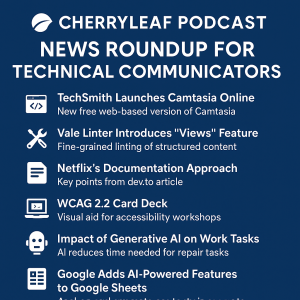
In this special episode of the Cherryleaf Podcast, we're doing something a little different - a curated roundup of recent news, tools, research, and resources especially relevant to technical communicators.
🔔 Highlights & Topics Covered:
🆕 TechSmith Launches Camtasia Online
🛠 Vale Linter Introduces “Views” Feature
📄 Netflix’s Documentation ApproachWe review “Documentation that Developers Actually Read: The Netflix Approach” by Pratjem Naik.
♿ Web Content Accessibility Guidelines (WCAG) 2.2 Card DeckJohannes Lehner’s printable & digital card deck for WCAG 2.2 helps with accessibility workshops and planning.
🤖 The Impact of Generative AI on Work TasksStanford & World Bank research shows how AI dramatically reduces time needed for tasks like repair and installation.
🔗 Microsoft Learn Docs & MCP (Model Context Protocol)New tool allows GitHub Copilot and other AI tools to retrieve contextually accurate, real-time Microsoft documentation.📹 Includes highlights from Peter de Bruyne’s YouTube demo
📊 Google Adds AI-Powered Features to Google SheetsGoogle Sheets now supports Gemini-powered prompts to analyse and generate personalised content based on spreadsheet data.
We'll also publish a transcript of this podcast on the Cherryleaf blog.
About Cherryleaf
Cherryleaf is a technical writing services and training company.
Cherryleaf
Cherryleaf Newsletter

Jun 12, 2025
Jun 12, 2025
21 min
The way users want to access information may be undergoing a seismic shift. Some have suggested technical communication is rapidly moving towards a question-and-answer (Q&A) paradigm.
As user behaviour moves away from reading and towards asking, we discuss how chatbots, AI, and Q&A-driven interfaces are reshaping the expectations and responsibilities of technical communicators.
Takeaway quote:"It’s not about crafting a list of 20 questions. It’s about building a robust knowledge system that can handle any question and deliver meaningful answers."
Resources
Michael Andrews and Ardis Ramey on Q&A communication paradigms
UK Government Digital Service post: FAQs: why we don’t have them
Cherryleaf Newsletter
We'll also publish a transcript of this podcast on the Cherryleaf blog.
About Cherryleaf
Cherryleaf is a technical writing services and training company.
Cherryleaf
May 12, 2025
May 12, 2025
28 min
In this episode, we dive into responses to the evolving digital landscape shaped by AI in search engines and changes in social media.
We explain how Cherryleaf took inspiration from the viral success of the Museum of English Rural Life (Merl) and used AI chatbots to analyse Merl's approach.
We share the key lessons learned - such as embracing an authentic voice, leveraging unique content, blending education with entertainment, and encouraging engagement - and details how Cherryleaf adapted these for a technical writing services company.
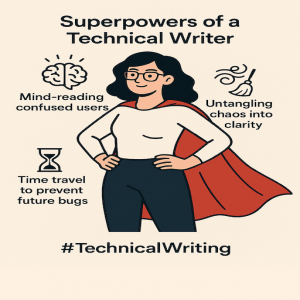
Discover the creative content pieces we've launched, including "Technical Writer Superpowers," "Technical Writing Bingo," and "Dungeons and Documents," and hear about the initial results in terms of engagement and reach. We also discuss future plans and how other organisations can adopt similar strategies.
Technical Writer Superpowers
Technical Writing Bingo
Dungeons and Documents
Technical writing jargon explained: 📦 Single-sourcing
Cherryleaf Newsletter